
Welcome
Have a look at our services or contact us directly.
Feature Archive
THz-Skin press release: THz-Skin Pathfinder Open: Pioneering Early Skin Cancer Detection

Skin cancer causes over 36,000 deaths in the EU every year and costs around €9 billion in healthcare and indirect costs. The THz-Skin Pathfinder Open project, starting 1 February 2026 and running for four years, aims to make early detection faster, safer, and more accessible. The project will develop a non-invasive, label-free diagnostic platform enabling real-time, zero-radiation screening without expensive equipment or specialist intervention.
A conceptual breakthrough of the project is to use the body’s natural thermal emission to detect cancer spectral fingerprints in the terahertz (THz) range. The concept was made possible by the recent project h-cube, implemented as ATTRACT Phase II program, that resulted in development broad and narrow-band bolometers providing THz detectors with an unprecedented combination of fast response and high sensitivity. These detectors will be the building blocks for miniaturized, low-cost Multifrequency Pixels (MFPs) sensors, enabling hyperspectral imaging in the 3–25 THz range. Diagnostics will be based on a growing, open-access, spectral fingerprint library and on AI diagnostics to detect subcutaneous cancer signatures.
The project funded by the European Commission is implemented by consortium of academic and industrial partners from Italy, Lithuania, the UK, Finland, and Switzerland. The kick-off meeting will take place in Joensuu on 12 February 2026, marking the start of this ambitious collaborative effort.
THz-Skin Pathfinder Open promises to revolutionize skin cancer diagnostics, enabling widespread screening, earlier treatment, and better patient outcomes across Europe.
Successful implementation of the THz-Skin project will enable simple-to-use diagnostic equipment available in a primary-care environment.
SCIPROM has accompanied the project from the proposal preparation on and is now in charge of management, communication and dissemination.
Please follow us on LinkedIn and read all about our project and consortium partners on the THz-Skin website.
The THz-Skin project has received funding under the European Union’s Horizon Europe programme.

THz-Skin: First press release available
Read the first press release of our new project THz-Skin and discover our objectives and consortium: https://www.thzskin.eu/
THz-Skin offers a transformative approach by detecting early-stage cancer spectral fingerprints from the skin’s thermal emissions, providing biochemical information from up to 1 mm beneath the surface. This enables fast, safe, and accurate screening based on underlying biochemical changes, offering a powerful, stand-alone tool for early detection without requiring visual inspection or specialist involvement at the first diagnostic stage.
THz-Skin - Reinventing skin cancer detection
We are pleased to announce that, together with eight European partners, we have launched a new project today: THz-Skin - THz-FIR Colour Imaging of Skin Condition Based on Analysis of Its Thermal Emission
Skin cancer is already among the most common cancers worldwide. If all forms, including often under-recorded non-melanoma types, were reliably screened and recorded, it would likely be a top global cancer incidence. In the EU alone, over 620,000 new cases are diagnosed annually, with associated healthcare costs exceeding €9 billion. These figures are projected to rise by up to 50% by 2030, placing increasing pressure on healthcare systems.
Effective skin cancer screening requires a method that is simple, non-invasive, low-cost, and scalable – ideally without needing a dermatologist for the initial assessment. AI-based tools perform well by analysing the shape of suspicious areas in images, but they are limited to surface-level, visual data at later cancer stages.
THz-Skin offers a transformative approach by detecting early-stage cancer spectral fingerprints from the skin’s thermal emissions, providing biochemical information from up to 1 mm beneath the surface. This enables fast, safe, and accurate screening based on underlying biochemical changes, offering a powerful, stand-alone tool for early detection without requiring visual inspection or specialist involvement at the first diagnostic stage.
With kind regards from SCIPROM
We would like to thank you all warmly for our excellent collaboration and the enjoyable moments we shared together in 2025. We look forward to seeing you again in 2026 and beyond!
Happy holidays and a peaceful and healthy 2026!
Joyeuses fêtes de fin d'année, que 2026 vous apporte plein de bonheur!
Schöne Weihnachtsferien, mögen alle Eure Wünsche für 2026 in Erfüllung gehen!
Buone feste e un magnifico anno!
Best wishes,
Véronique, Dominique, Filippo, Peter and Kirsten @ SCIPROM

PRISMAP's radionuclide deliveries
To mark the completion of the PRISMAP project, we have just published a press release providing an overview of the user projects funded by our European programme for medical radionuclides. The press release includes a delivery map where you can track all radionuclide deliveries made during the project's lifetime.
Enjoy reading!

Now published: Horizon Europe Work Programmes 2026-2027
All work programmes for the last two years of Horizon Europe, 2026 and 2027, have been officially published today. You can find them on the European Commission's website. In the coming days, all calls for proposals and individual topics will also be uploaded to the 'EU Funding and Tenders' portal.
Just have a look what's in for you - many of the calls will open for submission in the coming weeks.
Switzerland is now again an Associated Country to Horizon Europe and Swiss entities may participate as beneficiaries and coordinators.
Switzerland is Associated to EU Programmes again!
Today, the EU Programmes Agreement (EUPA) was signed in Bern by Federal Councillor Guy Parmelin and EU Commissioner Ekaterina Zaharieva. It applies with immediate effect, meaning that Switzerland is associated to Horizon Europe, the Euratom programme and the Digital Europe Programme (DEP) retroactively from 1 January 2025, will participate in ITER from 1 January 2026 and will be able to associate to Erasmus+ from 2027. The EUPA signing has taken place ahead of the Switzerland-EU package but remains part of this package.
Grant agreements of positively evaluated projects of calls for proposals 2025 can now be signed and project funding will come directly from the European Commission, as Switzerland makes a mandatory contribution to the EU for this purpose. In terms of participation opportunities, Swiss actors can once again take on the coordinating role in collaborative projects since calls for proposals 2025. Participation in mono-beneficiary projects, particularly those of the European Research Council (ERC), the European Innovation Council (EIC) and the Postdoctoral Fellowships of the Marie Skłodowska-Curie Actions (MSCA), is also possible again.
The latest news and information can be found at the SERI dedicated page and on our Euresearch website.
If you have any questions, join the Euresearch information events on "Swiss Access to Horizon Europe: Confirmed and Secured".
1st Event: 17.11.2025
2nd Event: 11.12.2025
3rd Event: 12.01.2026
Source: Euresearch
arXiv updates its practices after being inundated with AI-generated 'research papers'
According to their press release, the Computer Science (CS) category of arXiv has updated its moderation practices regarding survey articles and position papers. Before they can be considered for submission to the CS category of arXiv, survey articles and position papers must now have been accepted by a journal or conference and have undergone a successful peer review process. When submitting review articles or position papers, authors must include evidence of a successful peer review process in order for their contributions to be fully considered. Review/survey articles or position papers submitted to arXiv without this evidence are likely to be rejected and will not be published on arXiv.
This change is being implemented due to the unmanageable influx of review articles and position papers to arXiv CS. In recent years, arXiv has been inundated with articles. Generative AI/large language models have contributed to this flood by making it quick and easy to write articles, especially those that do not present new research findings. While all categories on arXiv have seen a sharp increase in submissions, this is particularly pronounced in the CS category of arXiv.
Upcoming Circular Economy Act: Public Consultation and Call for Evidence
The European Commission has launched a public consultation and the Call for Evidence for the upcoming Circular Economy Act.
With the Circular Economy Act the EC strives to enhance the EU’s economic security, competitiveness, while promoting more sustainable production and circular economy business models and decarbonisation. The Act shall facilitate the free movement of ‘circular’ products, secondary raw materials and waste. It shall also increase the supply of high-quality recycled materials and stimulate demand for these materials in the EU.
Your contributions will be taken into account to further develop and optimise this initiative.
The consultation runs until 6 November 2025, why not get started right away?
A dive into the i-EDGE project technology
Take a deep dive into the cutting-edge technology developed by the i-EDGE project that aims at enabling ultra-low-power electronics capable of operating in extreme environments — including high temperatures and intense radiation.
Discover it on the i-EDGE project outcomes page - along with many other interesting outcomes - to learn more on how i-EDGE is shaping the future of resilient, energy-efficient electronics.
IHI: Future opportunities
IHI published draft information on upcoming call topics a few months ahead of the official call launch. They do this to give you additional time to find or build a consortium and prepare a strong proposal. Note that as draft topics are still under development, the texts may change considerably between the versions published here and the call launch, and you should always check the final, approved topic texts once the calls are launched.
The following topics are under consideration for inclusion in IHI call 11, a two-stage call which is scheduled for launch in Q2 2025:
- Understanding how infections foster and induce non-communicable diseases
- Towards precision medicine: platform for transdiagnostic stratification of brain dysfunction
- AI-powered signal detection in pharmacovigilance
- Leveraging Europe's expertise to accelerate cell therapy for type 1 diabetes
- Establishing ortho and cardiology ambulatory surgical centres in Europe
For more information please visit the IHI website.
Our H2020 project MEFISTO successfully completed
Great to see MEFISTO successfully completed, a project which SCIPROM accompanied for more than 6 years, from the first idea to the final review. Congrats and a big thanks to all!
MEFISTO has just held its final review meeting with representatives of the European Commission. The project was congratulated by the EC representatives for its achievements. In the final phase, novel coating technologies were used to functionalise resorbable and non-resorbable meniscal implants. These implants were then tested in vivo in partial meniscectomy models.
The resorbable collagen scaffold produced by Geistlich and functionalised by Tissue Click was tested by the team at the University Hospital of Regensburg. Meanwhile, non-resorbable meniscus implants from Active Implants and ATRO Medical BV, functionalised by Tissue Click and the Universidad de Santiago de Compostela, were tested by the Humanitas University team.
Analysis of joint tissues and explanted devices suggests that Tissue Click's biomimetic nanostructured coating may provide protection to articular cartilage following meniscectomy. In addition, this coating technology has been shown to be both easily applied to meniscal devices and sterilisable.
Read our publishable summary for more insight into our achievements and stay tuned for further updates and publications on the exciting results of this collaboration!
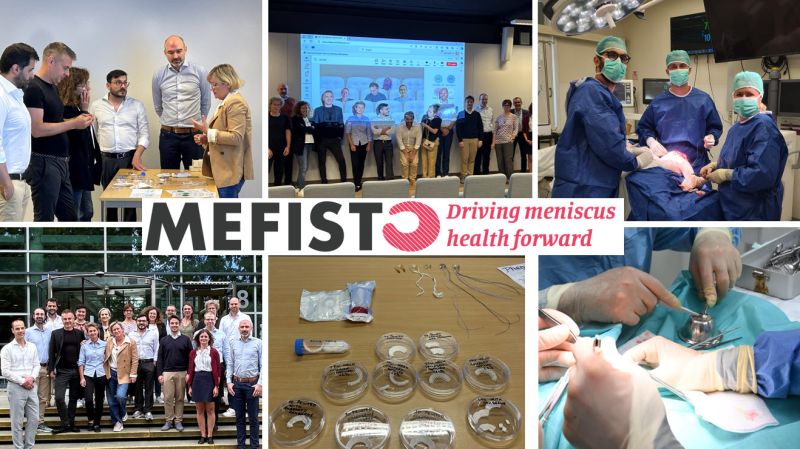
Moments from the MEFISTO project
Help shape EU's digital future!
The European Commission's DG CNECT is inviting experts in cutting-edge digital technologies to help shape future EU investment in research, innovation and deployment for the period 2028-2040.
This is your opportunity to shed critical light on emerging areas such as AI, quantum technologies, cybersecurity, robotics, and more.
Deadline for submission of your expression of interest is 20 January 2025, 18:00 CET.
You can find more information and the application form here.
Swiss association to Horizon Europe!
Great news! The EC has fully activated the transitional arrangement as of 1 January 2025, which enables researchers and innovators in Switzerland to participate in almost all calls for proposals of Horizon Europe and the Euratom programme as beneficiaries, from the 2025 programme year onwards. This means also that they can submit project proposals in the role of coordinator. Switzerland's participation in calls for proposals in areas considered strategic by the EU (including quantum and space) are still subject of discussions with the EC.
Running applications or projects are not impacted by this.
The latest news and information can be found at the dedicated SERI page.
ERC Proof of Concept Grants: Eligibility of researchers at Swiss host institutions
The European Research Council (ERC) announced today that researchers in Switzerland can participate in the ERC Proof of Concept call 2025. The transitional arrangements allow Swiss legal entities to be treated as ‘entities established in associated countries’ for the call for Proof of Concept Grants under the ERC Work Programme 2025. SERI has updated their information accordingly.
The call is expected to open tomorrow, 13 November 2024.
IHI future opportunities - draft texts of IHI calls 9 and 10 just published
IHI has a good habit of publishing drafts of future funding opportunities ahead of the call launch to give applicants extra time to start networking and preparing a proposal.
Now draft texts of IHI calls 9 and 10 have been published on the IHI website. Both calls are scheduled for launch in early 2025.
While call 9 is a single-stage, applicant driven call addressing the IHI Strategic Research and Innovation Agenda, call 10 is a standard two-stage call with topics on Per- and Poly-fluoroalkyl substance (PFAS), secondary use of health data and digital labelling.
SCIPROM invites you to explore the different call topics and will be happy to support you from the project idea to the elaboration of the proposal and the implementation of the project in all aspects of management, communication and dissemination of the project.